I came across this picture today while talking to my sister, and it sent me back 25 years for a brief moment. I took in all the details of the background – calendar paper used as wallpaper, video cassettes of TVB episodes, my sister and I in hand-me-down clothes, standing in the living room that also doubled as a bedroom for my two uncles.
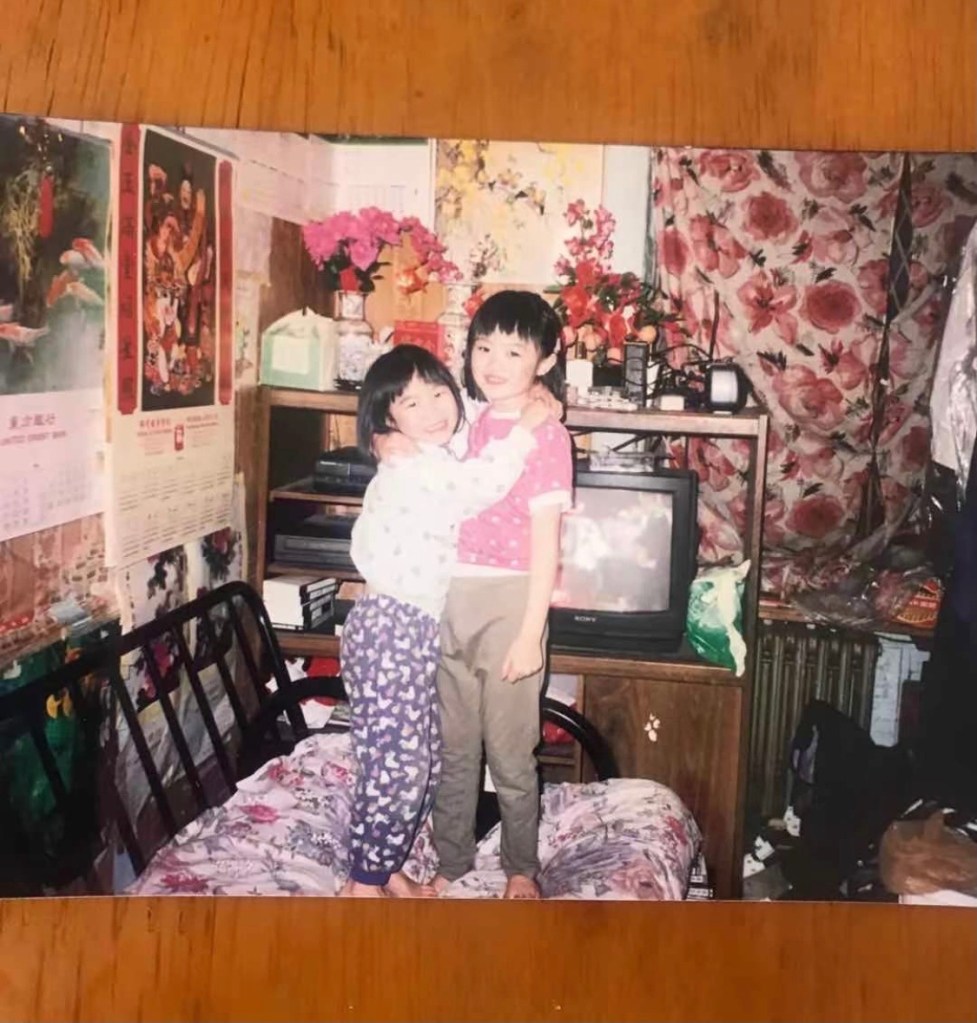
My sister mentioned that she couldn’t believe we used to live in a home like that, on Monroe Street in Chinatown. She’s a mom now herself, and she says this while sitting in the house she owns with her husband, where her own kid, my nephew, is crawling around a brightly lit and colorful living space full of a variety of toys and gadgets, amidst a giant smart TV playing children-friendly videos on YouTube.
We’ve come a long way since childhood, moving out of the poverty that our immigrant family faced for many years when they first came to New York. I grew up in the one-bedroom Chinatown apartment you see in the picture, then was raised in a government subsidized apartment for most of my life until moving out in my late 20’s. There’s a line from Sandra Cisneros’s House on Mango Street that is coming to mind.
“Friends and neighbors will say, What happened to that Esperanza? Where did she go with all those books and paper? Why did she march so far away? They will not know I have gone away to come back. For the ones I left behind. For the ones who cannot out.”
I think you can say I lived a life similar to the one Esperanza determined. I left for college and went on to study social work, getting my bachelor’s and master’s degrees in a helping profession. I came back to the city and began working in various settings as a case manager, a college counselor, a therapist, and now at a youth non-profit, working with youth who look like me and grew up in similar backgrounds, facing similar challenges as a child of Asian immigrants. The work cannot be more personal – it’s reflective of who I am and where I come from and what I wish for young people and their families to access – whether that is resources, opportunities, safety, confidence, or joy.
Though at the same time, I like to have the courage to offer a gentle counterpoint. And I say this with the utmost love. This isn’t simply just a story about someone from humble beginnings who studied and worked hard to surpass the odds and is now in a position to give back to their community. My path is still unfolding, though the journey I’ve taken so far has granted me so much meaning and purpose that I can say goes beyond obligation – but one of true fulfillment. Yet, like many second-generation, first-born daughters of immigrant parents, there is a constant, looming pressure to take on a lifelong duty of responsibility which ultimately becomes integrated with our own identities. Responsibility may take shape in various forms whether through financial means, the decisions we make that considers the collective, the emotional presence and containment we provide, or the practical and logistical help our parents need.
I never considered the option to diverge, and yet the option to diverge from the return path can be a rightful one. What is unique about the Asian American experience is that it doesn’t have to look one particular way despite the origins and narratives we share. Our path continuously forms and develops and is one where we get to pave with our imagination and our hearts. We can actually have both sides of the coin without having to abandon ourselves. We can hold the significance and sacredness of our roots while walking a path that is uniquely ours, aligned with who we are and want to become.
I put this here as a reminder that I’m still walking the path. Whether I decide to continue as I am or diverge into a new path, that choice is mine to make. I trust that wherever it is I go, my origins come with me. What I value in life, what I hold meaningful, or the facets of my identities.


 Pen and Flow
Leave a comment